


Kenyatta University Center for Gender Equity and Empowerment in collaboration with Kenyatta University Women’s Economic empowerment hub celebrated the International Women’s Day on 7th March 2024 at BSSC room 14. This year the theme was Accelerate Action for Women and Girls: Rights. Equality. Empowerment”. The theme wished to call upon the society and the world at large to not only recognize the potential of women, but also include them in the development agenda.
The event was attended by members of management, members of staff, members of KUSA congress and students.
The speakers of the event were;
- Chief Guest, Prof. James Kung’u, Ag. Deputy Vice-Chancellor (Academic), representing KU’s Acting Vice-Chancellor, Prof. Waceke Wanjohi,
- Prof. Richard O. Oduor, Registrar (Research, Innovation and Outreach) representing Prof. Caroline L. Thoruwa, Ag. Deputy Vice-Chancellor (Research Innovation and Outreach)
- Prof. Judith N. Waudo, Director, Centre for Gender Equity &Empowerment and KU-WEE Hub Leader;
Prof. Richard O. Oduor, Registrar (Research, Innovation and Outreach) representing Prof. Caroline L. Thoruwa, Ag. Deputy Vice-Chancellor (Research Innovation and Outreach) in his remarks pointed out that in order to accelerate action for women and girls to protect their rights, promote equality and empower them, the legal system needs to effectively enforce its laws and regulations, women should be included in decision making by being appointed to leadership roles and should “sit on the table but not under the table” to make rules that affect their lives socially, economically and health wise. Additionally, girls should be educated to make informed decisions on themselves and others. Gender parity in technical jobs can be minimized by encouraging girls from a young age to take up STEM (Science, Technology, Engineering, and Mathematics) oriented carriers and better pay.
Prof. James Kung’u, Ag. Deputy Vice-Chancellor (Academic), representing KU’s Acting Vice-Chancellor, Prof. Waceke Wanjohi, in his remarks noted that although women have made great strides in many areas but in some areas their participation and accomplishments remain dismissal due to past, socio-norms and cultural barriers such as limited access to education, leadership, political participation, decision making and economic development have negatively affected women’s advancement. However, today, as more girls access education, they are taking up leadership positions. Women are shining in academia, politics, business, media and the private sector. Through mentorship, young women can be guided to see their potential, support them in navigating the complexities of academic and professional life, and empower them to step into their own leadership roles.
Further, Prof. Kungu, pointed out how the Constitution of Kenya reiterates the principle of empowering people with special needs, mainstreaming gender and enhancing support to orphans so as to reduce dependency in all aspects of the society, by affirming that women and men have the rights to equal treatment, including the right to equal opportunities in political, economic, cultural and social spheres. Consequently, Kenyatta University is committed to the principle of equity and equality, appreciates the impact female leaders can have and recognises that leadership is only effective when it is it is inclusive, diverse, and responsive to the voices and needs of men and women, boys and girls.
Prof. Kung’u concluded the speech by re-affirming Kenyatta University’s commitment to continue Promoting an atmosphere where there is zero tolerance to gender based violence, Providing safe spaces for working and learning and ensuring that men and women are not only represented but also participate adequately in discussions that relate to their wellbeing.
Panel Discussion
This year’s theme is Accelerate Action for Women and Girls: Rights. Equality. Empowerment focused on and emphasizing the importance of taking swift and decisive steps to achieve gender equality. It calls for increased momentum and urgency in addressing the systemic barriers and biases that women face, both in personal and professional spheres.
Led by Dr. Regina Mwatha, KU WEE Hub, Project Leader, an open discussion revolving around prevention of sexual and gender based violence to promote a safe learning and working environment at Kenyatta University was held. The panellists were;
- Prof. Bernard Kivunge, Registrar, Academic spoke on the major steps Kenyatta University has put in place to address Gender Based Violence? In his response he pointed out that regular sensitization and awareness creation is done. Students are encouraged to come forward and report harassment from fellow students, faculty staff and non-teaching staff. Further, there are disciplinary measures depending on the levels of crime and may lead to suspension, expulsion or termination of employment. He concluded by urging the participants to report GBV cases and not suffer in silence.
- Prof. Grace Ngare, Advocacy and Policy Expert, KU-WEE Hub- talked about Gender Based Violence status in Kenya today and what is the rationale for the 2025 IWD theme. According to the research that has been carried out in the media, police and the government shows that, both men and women are experiencing gender based violence. However, GBV is very rampant among women and girls. Research shows that most women experiencing GBV are in the age bracket of 15-49 years. She pointed out that, excessive use of alcohol and drug abuse is a huge contributor to GBV as it aggravates the abuser and incapacitates the survivor or victim. Additionally, the legal system has policies but there is a challenge of implementing it. To conclude, Prof. Ngare noted that GBV does not happen overnight; it is a process, so, watch out and run; be active bystanders; take action.
- Dr. Gabriel Waari, Director Health Services – talked about is done when a case of rape is taken to health unit; and what steps do you take to ensure that there is tight evidence in case of litigation. There is aguideline whereby the evidence is in form of a health report. Post rape care is done by a medic where the survivor is examined, swabs are taken looking for sperms, test the urine for blood and torn clothes especially underwear. Psychologically, there are counselling services for survivors in emotional distress. Dr. Waari pointed out that the challenge they face most is late reporting and other come to report after showering therefore making it difficult to collect any usable DNA samples. Further, he informed participants that medical care is 24 hours 7 days a week and there is a 72 hour window for PEP.
- Dr. George Oyombra, Director Security Services- highlighted on the steps taken when a case of GBV is reported and mechanisms have in place to ensure that GBV survivors receive immediate justice. It depends on the nature of GBV case. For instance, if it is rape, the survivor is to report to health unit immediately, then write a statement at the police station and finally go through the legal system for prosecution. If its assault, a statement is written and witnesses are invited to make statements as well, the directorate does further investigations and forwards the case to University disciplinary to decide on final punishment. Dr. Oyombra pointed out that most GBV cases are under reported due to threats, stigma. Etc. however, he encouraged reporting and assured safety and confidentiality.
- Mr. Edwin Musembi, Dept. of Gender and Development Studies- spoke on push factors that support GBV at the Kenyatta University. Some of the factors highlighted were;
a. Cultural norms
b. Unsafe spaces like unlit paths
c. Stigmatization due to societal norms
d. Financial distress
e. Drug abuse in campus
f. Not knowing where to report
He concluded by encouraging members present to download the KU SGBV REPORT App and further urged fellow men to come forward and report, and not let their silence slowly consume them.
Conclusion
From the above discussion, all panellists agreed that;
- GBV is one of the greatest barriers to growth for both genders but largely women.
- Most survivors do not report GBV cases due to fear and stigma.
- Reporting is the most convenient way to stop perpetrators and not enable them by keeping quiet.
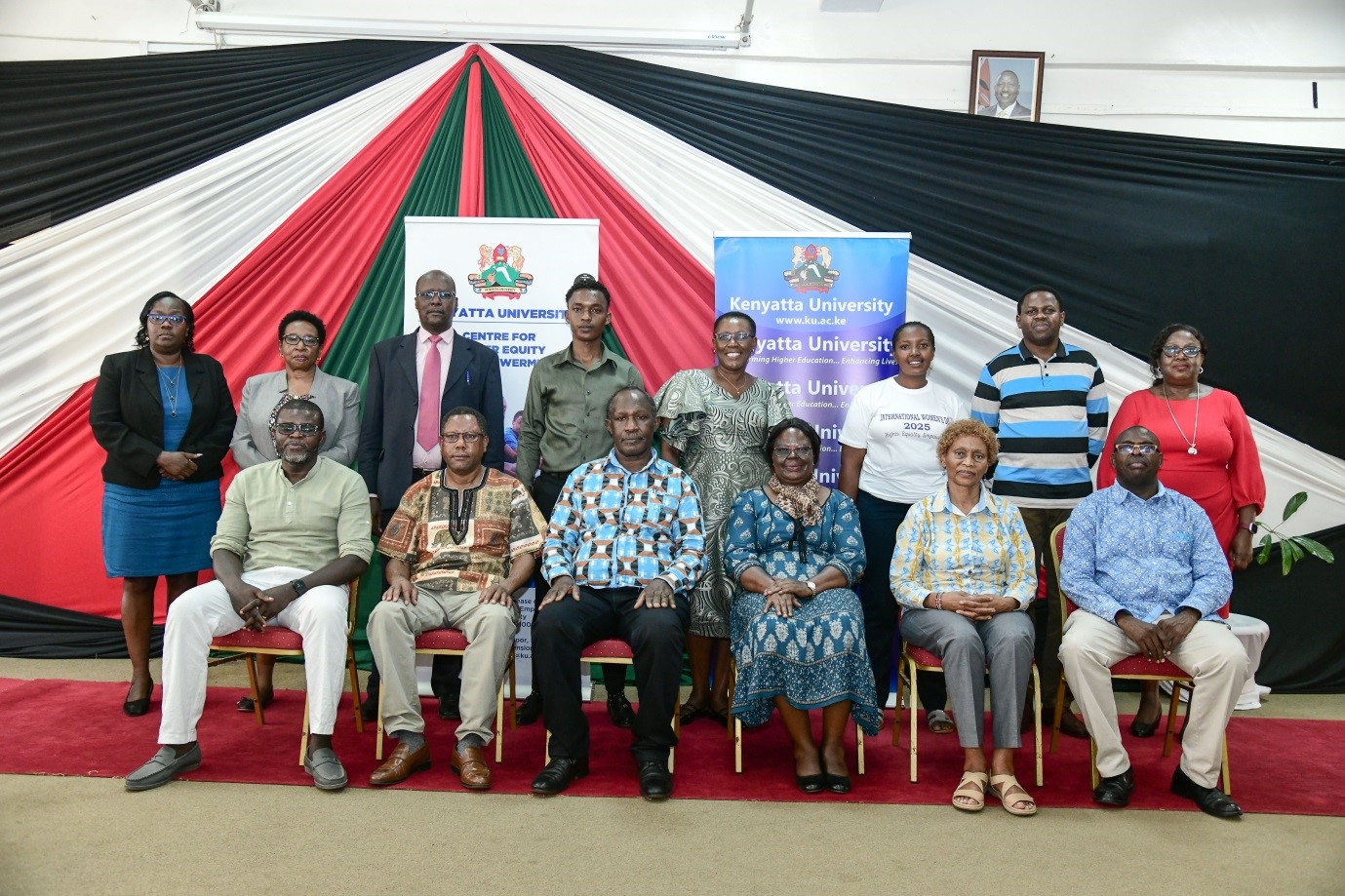
Chief Guest, Prof. James Kung’u, Ag. Deputy Vice-Chancellor (Academic) with selected members of staff present.
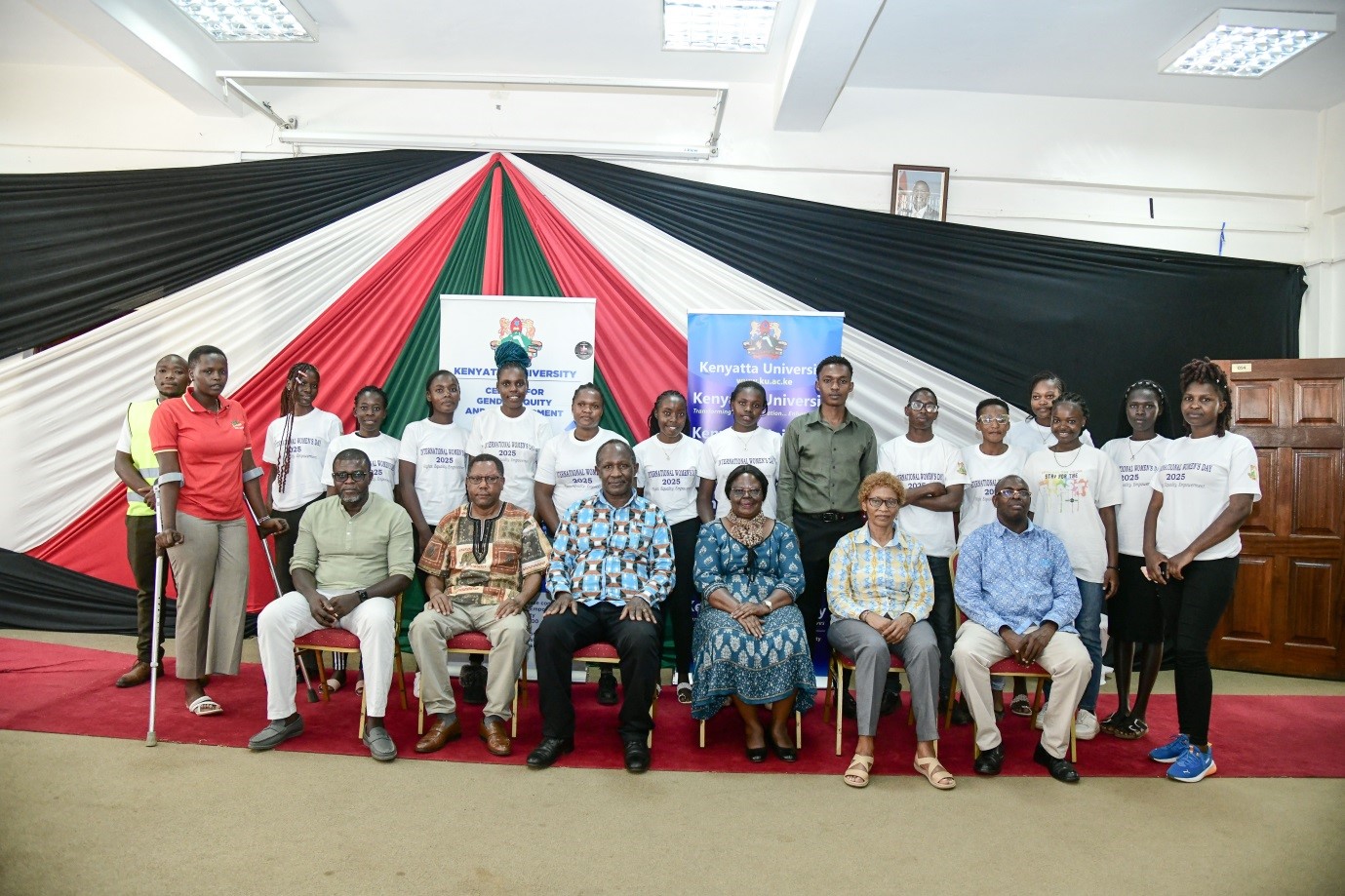
Chief Guest, Prof. James Kung’u, Ag. Deputy Vice-Chancellor (Academic) with selected student participants.
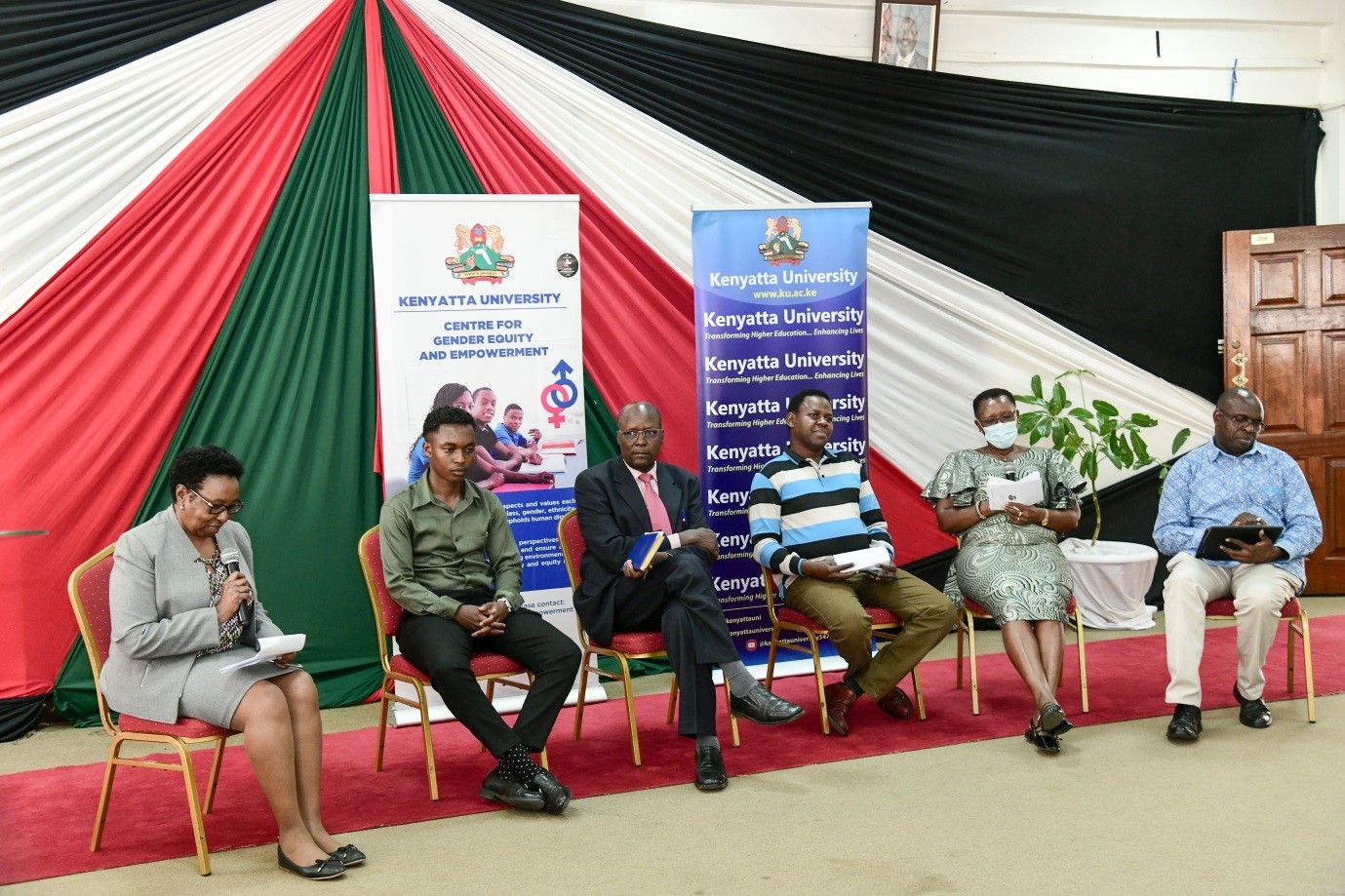
Dr. Regina Mwatha, KU WEE Hub, Project Leader (far left) presiding over an open discussion revolving around prevention of sexual and gender based violence to promote a safe learning and working environment at Kenyatta University
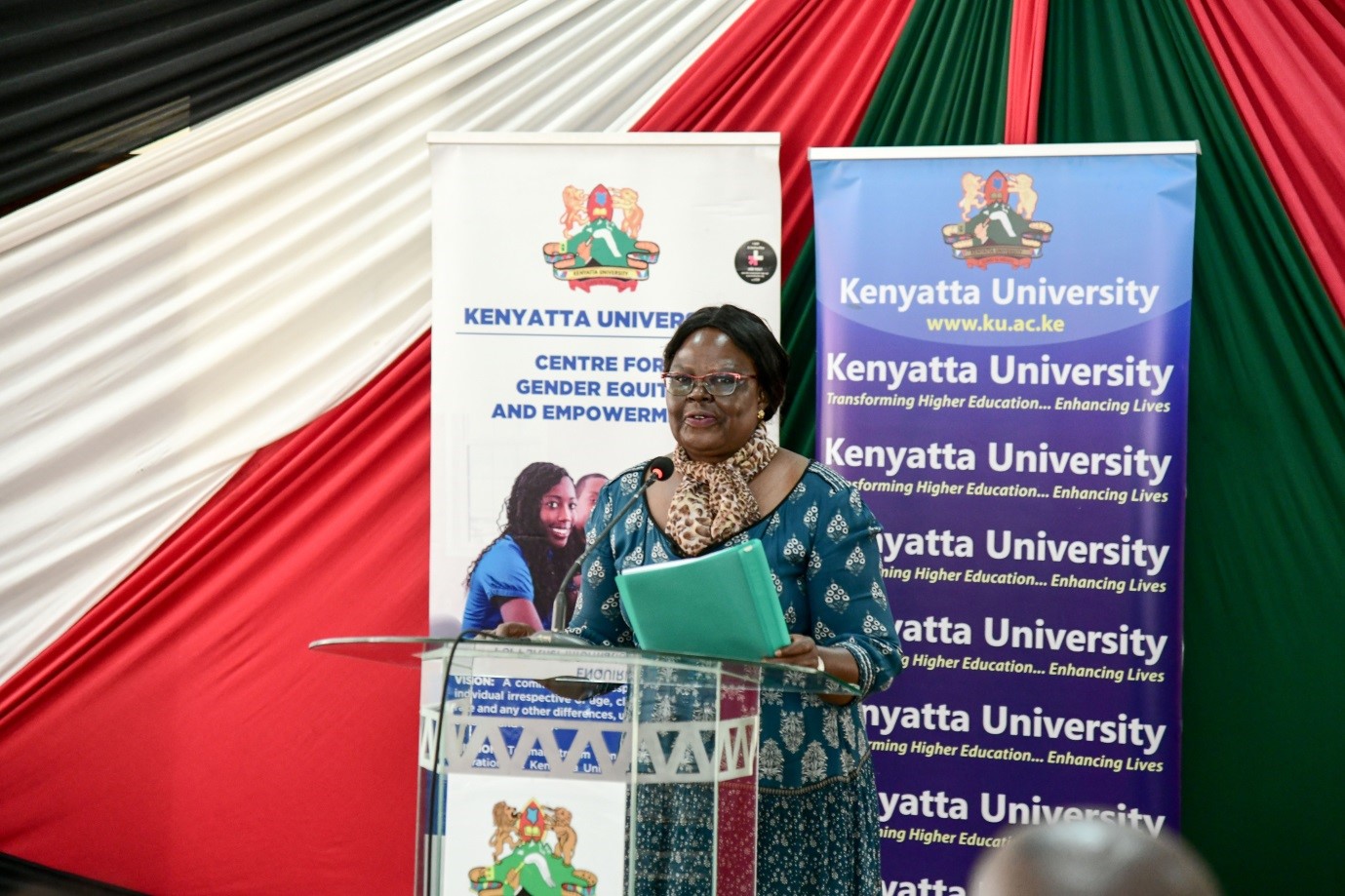
Prof. Waudo addressing participants during the International Women’s Day
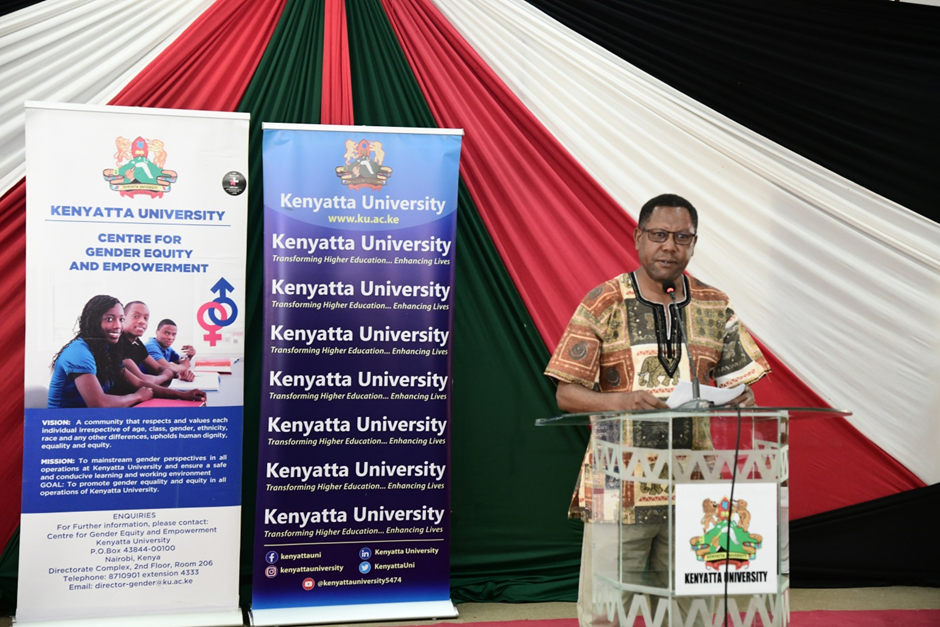
Prof. Nicolus Gikonyo representing Prof. Caroline L. Thoruwa, Ag. Deputy Vice-Chancellor (Research Innovation and Outreach)
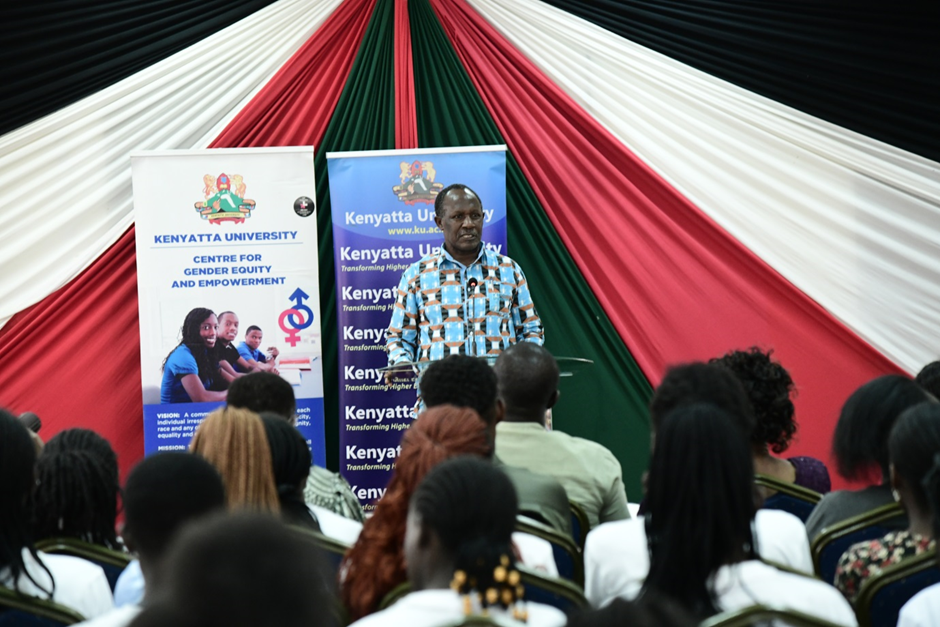
Chief Guest, Prof. James Kung’u, Ag. Deputy Vice-Chancellor (Academic), representing KU’s Acting Vice-Chancellor, Prof. Waceke Wanjohi
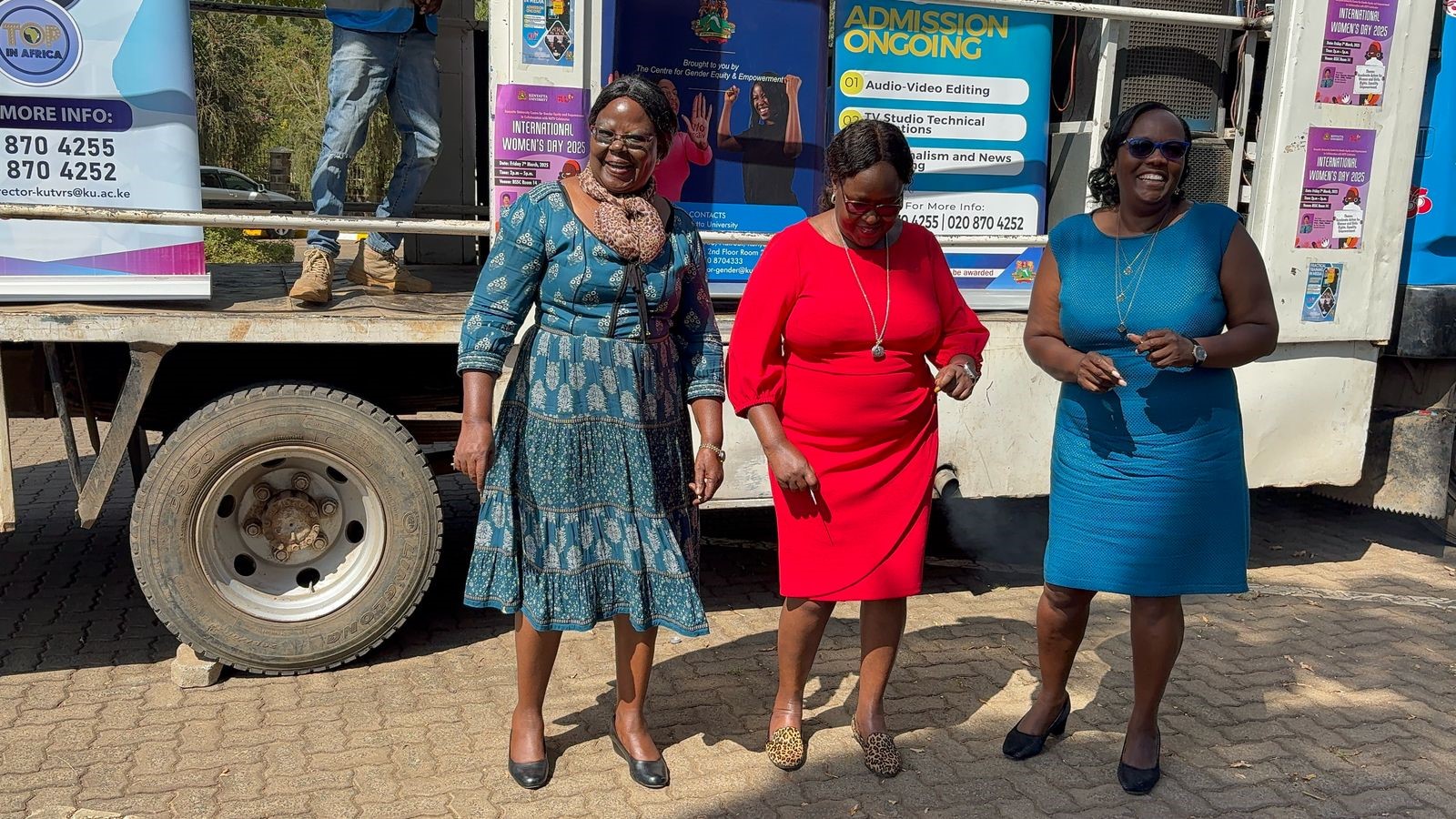
Project staff flagging off the caravan on 7th March 2025, International Women’s Day


